 Understand your Thailand options. Book a consultation with Tarn →
Understand your Thailand options. Book a consultation with Tarn →

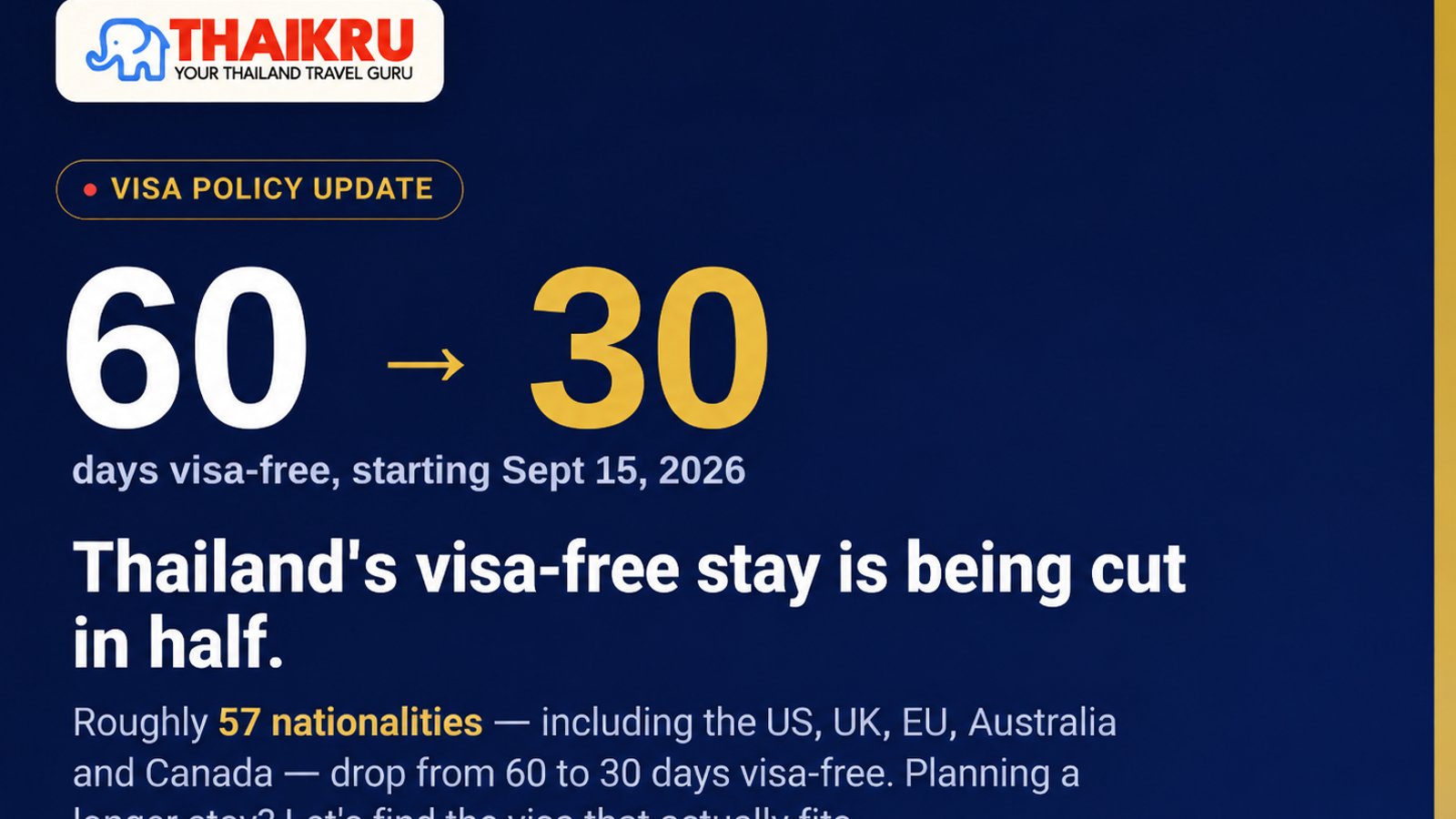
From 15 September 2026, Thailand's visa-free stay drops from 60 days to 30 for 60 nationalities. Here's what's confirmed, what's grandfathered, and what to do about it.


Talk with our Thailand Specialists Numfhon, Tarn or Eric.
★★★★★ 5.0 on Google · Best Thailand visa agency
It's the weekend in Bangkok, we'll reply on Monday.
Bangkok · Pattaya · Chiang Mai · Phuket · Koh Samui
100% money-back guarantee
Every time Thailand touches its visa rules, the same thing happens.
Within about four hours, one Facebook group declares that Thailand has banned tourism forever. Another insists nothing has changed and everyone should calm down. A YouTube thumbnail appears with a red arrow and the word BANNED in 90-point font. Somebody's cousin who "knows a guy at immigration" weighs in. And roughly 40,000 people make travel decisions based on whichever post they scrolled past first.
So let's do this properly, with the actual gazetted rule in front of us.
From 15 September 2026, Thailand's visa-exempt stay drops from 60 days to 30 days.
That's it. That's the change. Now here's what it actually means for you — including the three parts that most of the panic content is getting wrong.
The Interior Ministry notification is published and in force from 15 September 2026. It repeals the previous visa-exemption schemes from 2019 and 2022, and it does four things:
1. Sixty countries and territories now get 30 days, not 60. That list includes the US, UK, Canada, Australia, Japan, India, Singapore, and most of the EU. If your passport got you 60 days on arrival any time since July 2024, assume you're on this list.
2. Two countries drop to 15 days. Mauritius and Seychelles.
3. Land border visa-exempt entries are capped at two per calendar year. This one's getting less attention than it deserves, and it's arguably the bigger deal. Nationals of Malaysia, Brunei, Indonesia and Singapore are exempt from the cap. Everyone else: two land crossings on a visa exemption, per calendar year, full stop.
4. The reasoning is on the record. Authorities cited national security and economic considerations, and have been notably direct about the specific behaviours behind it: people working remotely without the right visa, and people running informal businesses without a work permit. This is not a subtle policy. It's aimed squarely at long-stayers who've been using the tourist lane.
You can still extend. One extension of up to 30 additional days, at any immigration office, for around 1,900 THB. That's unchanged.
So the honest maths is: 30 + 30 = 60 days maximum without a visa. Which is exactly what you used to get on arrival, before extending. The old ceiling was 90. The new ceiling is 60. That's a real cut — a third of your runway gone — but it's not the "you now get one month and that's final" story going around.
And if you're already here, or arriving this week, you're fine.
This is the single most misunderstood point right now, so read it twice: travellers who enter Thailand on or before 14 September 2026 keep the stay they were granted on entry. Anyone already in the country keeps their permitted stay. Nobody is being cut short retroactively. Your existing stamp is not going to spontaneously expire on the 15th because a rule changed around you.
If you were planning to arrive in the next eleven days anyway, land before the 14th and you've bought yourself the old 60 days one final time.
Let's be blunt about the tiers here, because "this affects everyone" is not useful information.
If you're coming for a two-week holiday: this changes nothing for you. You were never going to use 60 days. Book the flight. Enjoy Krabi.
If you're a repeat visitor doing 4–8 weeks at a time: mildly annoying. You'll need to plan an extension into your trip, budget the 1,900 THB, and spend an afternoon at an immigration office you'd previously been able to avoid.
If you've been using visa-free entries as a de facto long-stay strategy: this is the one aimed at you, and it's worth being honest about that. Hopping to Vientiane every couple of months, stacking exemptions, treating the visa question as something to sort out "eventually" — that approach just lost a third of its runway, gained a hard land-border cap, and is now operating in an environment where the government has openly said this is the behaviour it's targeting.
Which means the scrutiny question matters more than the day count. A 30-day stamp is not the problem. Being visibly a long-term resident of Thailand who has never held a long-term visa — that's the problem, and it was already a problem before 15 September.
The fix for this is not a better border run. There is no clever routing, no magic entry point, no immigration office in a small province that hasn't got the memo. The rule is national and it's gazetted.
The fix is holding a visa that actually matches what you're doing here.
The good news — and it is genuinely good news — is that Thailand has more long-stay options now than it did five years ago, not fewer. The DTV exists. The LTR exists. Retirement, education and work visas all exist and all work. The country did not close the door; it closed the hallway people were using instead of the door.
Broadly:
Which of those is right for you depends on your age, nationality, income structure, and what you're actually doing in Thailand day to day. Those aren't rhetorical variables — they're the difference between an approval and a rejection, and anyone who names your visa before asking about them is guessing.
Arriving before 15 September? Land on or before the 14th and you keep 60 days on that entry. If your flight is already on the 16th and moving it is cheap, moving it is worth considering.
Already in Thailand? Check what your stamp actually says and when it expires. Your current stay is safe; what matters is what happens when it ends.
Planning to be here longer than two months, ever? Stop planning around the exemption. Start planning around a visa. The exemption was never designed to be a residency programme, and as of 15 September it's considerably worse at pretending to be one.
Thai Kru exists because immigration information online is a mess — contradictory, out of date, and frequently written by people who've never actually filed the application they're describing. We read the gazette notifications. We track how individual offices are applying them. And we tell you what applies to your situation, not to a hypothetical average foreigner.
Before 15 September, ideally. You've got more options while you still have 60 days than you will with 30.
This article is general information, not legal advice. Thai immigration rules change quickly and are applied differently from office to office. Verified against published sources on 3 September 2026 — if you're reading this well after that date, check with us before acting on it.
A 1-hour video call with a Thailand visa expert. A written plan in your inbox within 24 hours. And a full year of email and chat support to keep you on track.